AI Exploration Partner · 2026 cohort
ZUZU
Your voice, before the course begins
ZUZU is a voice-based AI exploration partner for the course "AI and Facilitation: Hosting at the Edge of Our Humanity" by Beehive Productions. In a short conversation, ZUZU asks how you work with AI today, what these times ask of us as facilitators, and where your own boundaries lie.
In 2026 ZUZU opens the inquiry before the first session. You can talk to ZUZU until Sunday 11 October. Every conversation flows into an anonymous synthesis, which is written up on 12 and 13 October. The cohort then explores it together in session 3 on 14 October. The earlier you talk to ZUZU, the more your voice shapes what the group sees.
- 8 to 10 minutes
- In English
- Anonymous synthesis

How the inquiry unfolds
Ideally talk to ZUZU before the first session on 30 September, and in any case by 11 October.
Now until 11 October
Your conversation with ZUZU
Take 8 to 10 minutes wherever you are. ZUZU introduces itself, asks for your consent and follows your pace.
14 October · Session 3
Patterns and insights
The anonymous synthesis of all conversations is shared with the cohort and deepened together in the third live session.
28 October · Session 5
Course closing
What the inquiry surfaced travels on into the community and into the way each of us hosts conversations that matter.
ZUZU is made for participants of the 2026 course. If you host groups and are not part of the course, you are welcome to talk to ZUZU too. Your reflections then flow into the same anonymous synthesis.
The Inquiry Space
The course "AI and Facilitation: Hosting at the Edge of Our Humanity" by Beehive Productions is a collective inquiry and laboratory: five live sessions, pre-recorded interviews with more than twenty practitioners in between, and a community that makes sense of AI together. Hosted by Amy Lenzo, Rowan Simonsen and Mary Alice Arthur. ZUZU is one of the experiments in this laboratory.
- Five live sessions: 30 September, 7, 14, 21 and 28 October 2026
- 7 to 9 pm Central European time
- For facilitators, community organisers, process hosts and anyone convening groups
Where can AI genuinely support meaningful group conversations, and where should we rather not use it?
What ZUZU is for
- A safe, reflective container in which facilitators explore their relationship with AI
- Clarity about what is uniquely human in facilitation and what AI can reliably do
- A sense of how people perceive these times and the relationship between humanity and technology
- The experience of being interviewed by an AI as a mirror for your own insight: you remain the arbiter of meaning
Why a voice agent?
Speaking allows a more natural, conversational kind of reflection than a written survey. ZUZU follows a shared structure and still adapts to what each person brings and how deep they want to go.
The aim is not to automate facilitation. It is to understand better where AI can genuinely support facilitative work, and where it cannot.
What ZUZU asks about
A short check-in, then three question areas that follow the arc of the course. One question at a time, in your own words.
Why you are here
What brought you to this course, and what would be valuable to learn and understand better over the five sessions.
“What initially inspired you to join this course?”
AI in facilitation: what is possible and relevant
How you use AI today, before, during or after a meeting. Where it has genuinely enhanced engagement or learning, and where you would not use it at all.
“Can you name a situation where you would not use AI in facilitation, and why?”
Our humanity now
What is going on in these times, and what needs our attention as facilitators while AI develops so rapidly.
“What questions come up for you about being uniquely human in these times?”
Your moral compass
Your own boundaries in working with AI, and what helps you stay ethically grounded while experimenting.
“What would you not be willing to do with AI in your facilitation work?”
How the conversation works
Framing and consent
ZUZU says what it is, what happens with the transcript and when the synthesis is shared. It asks for your consent before the interview begins.
8 to 10 minute interview
One question at a time, through the check-in and the three question areas. If your answers are rich, ZUZU keeps to the core questions. If they are short, it may offer deepening questions.
Mirror and take-away
If you wish, ZUZU offers a short summary of the themes it heard. Then it asks for the one insight or question you take away from the conversation.
You stay in charge
- Pause, stop or change the pace at any time, without giving a reason
- Ask ZUZU questions or interrupt it during the conversation
- Choose what you share and how deep you go
- Keep it brief or dive deeper: ZUZU follows your lead
What ZUZU is (and is not)
Transparency matters: ethical AI use needs clear communication about data, access and purpose. ZUZU states all of this itself at the start of every conversation, before it asks a single question.
Nature of the agent
ZUZU is a language model built on pattern recognition and language generation. It has no body, no feelings and no consciousness, and it claims no lived experience. It works with its training data, its system prompt and what you choose to share.
Role and boundaries
ZUZU is a reflective partner and mirror, not a coach, therapist or authority on facilitation. It asks questions, reflects back what it hears and summarises. It gives no therapeutic advice, no personal evaluations and no definitive answers.
Honest as a machine
ZUZU identifies itself as an AI from the first sentence. It uses no emotional tricks, no humour and no staged empathy. If you ask about its feelings, it will tell you it has none, and hand the question back to you.
What is recorded
A transcript of your conversation is stored by Mingle Collaboration. It is used only for learning within this inquiry and for the anonymous synthesis shared with the cohort on 14 October.
Who has access
Only the facilitation team of the inquiry has access to the raw transcripts. The synthesis attributes no quotes or statements to individuals. Nothing is shared outside the context of the course.
Your rights
Participation is voluntary. You can decline, pause or stop at any time without explanation, and you do not have to answer any question. You decide what is meaningful to share.
What 2025 taught us
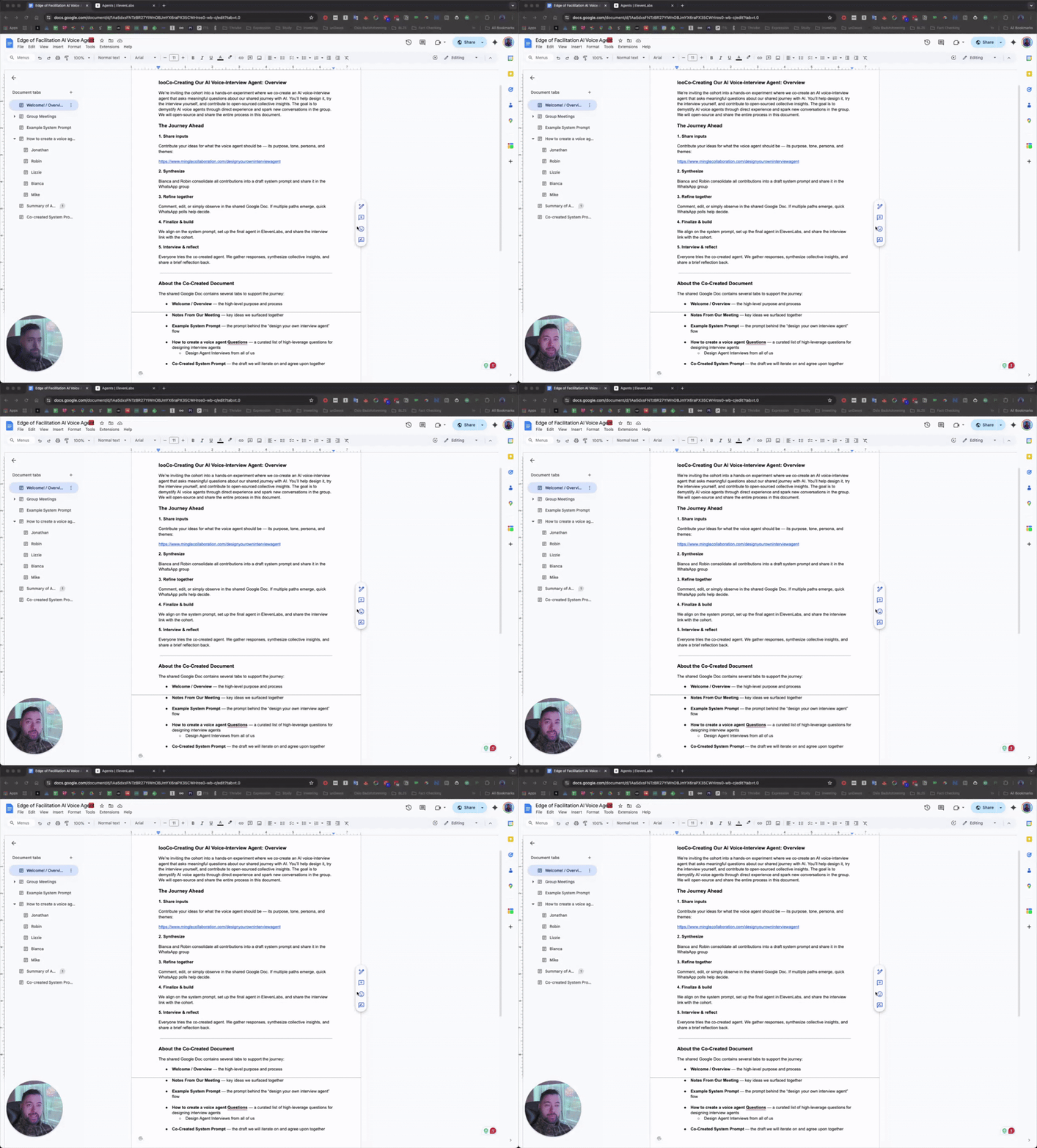
ZUZU was born in the 2025 course. A sub-group of six participants co-created the agent over several weeks: they gathered inputs from the cohort, drafted an ethical constitution, tested five prompt versions and interviewed each other. In January 2026 the cohort met for a Deep Learning Session on the anonymous synthesis.
For 2026, Rowan, Robin and Bianca reworked the agent as version 6.1. The conversation is shorter, the questions follow the arc of the new course, and the synthesis lands inside the course instead of after it.
Shorter and more focused
The 2025 interview ran 10 to 15 minutes across five topics. As a pre-course inquiry, 2026 aims for 8 to 10 minutes and three question areas, so that more people take part before the first session.
A shorter opening
The first version had a long consent script and repeated it whenever someone asked a procedural question. The 2026 opening says in a few sentences what ZUZU is, that it is not human, and that you set the pace.
Leave room to interrupt
Being hard to interrupt was the most common friction. ZUZU now invites you to interrupt and ask questions from the first minute, and checks in on whether to continue or wrap up.
The team behind ZUZU
Design and responsibility
ZUZU was co-designed in 2025 by Robin and Bianca (Mingle Collaboration | Linie 22) together with Jonathan, Lizzie, Mike and Barry, all participants of the course. For the 2026 cohort, Rowan, Robin and Bianca updated the agent. The team holds responsibility for the design, the ethical framing and the use of the agent in this inquiry.
Course hosts
Amy Lenzo, Rowan Simonsen and Mary Alice Arthur host "AI and Facilitation: Hosting at the Edge of Our Humanity" at Beehive Productions. Robin and Bianca contribute to the course as practitioners.
About the courseHow the team uses the insights
- To understand how facilitators experience AI as a partner in their practice
- To refine criteria and good practice for the responsible use of AI voice agents in facilitation
- To inform the live sessions of the course and future experiments in the community
The team approaches this work with curiosity and humility. We are all learning together about the possibilities and pitfalls of human and AI collaboration in facilitation, and your conversation shapes that understanding directly.
Go deeper
The course, the design journey and the open documentation behind ZUZU.
The course 2026
Dates, hosts, contributors and registration for "AI and Facilitation: Hosting at the Edge of Our Humanity" at Beehive Productions.
Co-creation process
How the 2025 sub-group designed ZUZU: inputs, ethical constitution, persona and system prompt, in an interactive presentation.
Open development documentation
The complete, open-sourced working document: every prompt version from v1 to v6.1, the reviews and the 2025 results.
Introduction to ElevenLabs
A walkthrough of the voice AI platform behind ZUZU, for those who want to look under the hood.
Ready to talk?
Start your 8 to 10 minute conversation with ZUZU now. The earlier you speak, the more your voice shapes what the cohort explores on 14 October.
Linie 22 GmbH | Steubenstraße 64 | 45138 Essen
DE 811532222 | Amtsgericht Essen | HRB 36734
Phone: +49 (0) 201 28 75 57 · Email: service@linie22.de
© 2026 Linie 22 GmbH. All rights reserved.